
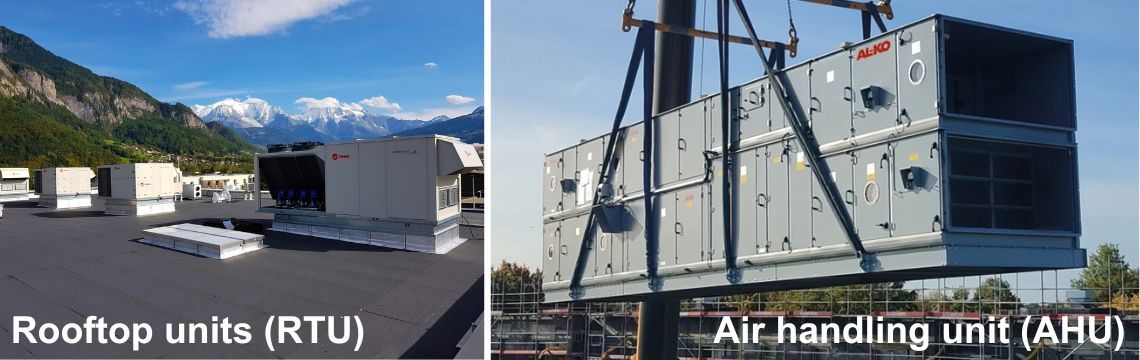
As HVAC designers and engineers, we know that there is no "one-size-fits-all" approach to climate control. Every building has a unique footprint, operational profile, and set of performance goals. When it comes to selecting the primary ventilation and air conditioning equipment, one of the most common crossroads engineers face is choosing between a Packaged Air Handling Unit (AHU) and a Rooftop Unit (RTU).
Both systems are capable of delivering exceptional comfort and efficiency, but selecting the right one requires a deeper understanding of the specific demands of your project.
Here are the critical factors you should take into account when navigating the AHU vs. RTU decision.
1. Spatial Constraints and Location
The most immediate differentiator is often where the unit will be installed.
• Rooftop Units (RTUs): As the name implies, RTUs are designed to sit on the roof or at grade level outside the building. This is a massive advantage when indoor mechanical space is at a premium, making them a go-to for retail stores, warehouses, and low-rise commercial buildings. By moving the equipment outside, you maximize leasable or usable indoor square footage. RTU systems also typically have a smaller footprint, since the heat pump or air-conditioning module is fully integrated.
• Air Handling Units (AHUs): Packaged AHUs can be installed outdoors, but they are frequently housed indoors within dedicated mechanical rooms. While this consumes indoor space, it provides significant benefits: the equipment is shielded from harsh weather conditions, extending its lifespan, and maintenance personnel can service the unit comfortably year-round, regardless of snow, rain, or extreme heat.
2. Customization and Application Complexity
How complex are your building's indoor air quality (IAQ) and thermal requirements?
• The AHU Advantage: If your project is a hospital, a laboratory, or a high-end commercial space with stringent IAQ, filtration, or humidity control requirements, the AHU is often the winner. AHUs are highly modular. You can custom-specify every component, for example advanced HEPA filtration, specialized thermal recovery wheels, specific fan arrays and acoustic treatments. They are designed to integrate seamlessly with a central chilled water or hot water plant.
• The RTU Advantage: RTUs are pre-engineered, "all-in-one" factory-fitted packaged systems. They contain the compressor, condenser, evaporator, and fan all in one weatherproof casing. While modern RTUs (like Trane's Airfinity range) offer excellent options for energy recovery and advanced controls, they generally offer less bespoke customization than an AHU. They shine in standard commercial applications where a proven, reliable, and standardized configuration gets the job done.
3. Installation Speed and Project Timelines
Time is money on a construction site.
• RTUs: Because they are factory-assembled and pre-charged with refrigerant, RTUs offer a "plug-and-play" installation. Once hoisted onto the roof curb and connected to ductwork and power, they are nearly ready to go. This significantly reduces on-site labor and accelerates project timelines.
• AHUs: Depending on the size and complexity, AHUs may require more extensive on-site assembly. They also require piping connections to central chillers or boilers, meaning coordination between multiple trades is necessary.
4. Long-Term Maintenance and Total Cost of Ownership
RTU systems are often 10 to 50% cheaper than AHU equivalents. But the initial capital cost is only one piece of the puzzle.
• Lifespan: Indoor AHUs typically enjoy a longer operational lifespan than RTUs because they aren't subject to the relentless wear and tear of sun, wind, rain, and ice. Moreover, RTUs contain more mechanical parts inside the casing, such as compressors, which are subject to wear.
• Serviceability: Maintaining an RTU requires roof access, which can be challenging during inclement weather and may raise safety considerations. Conversely, an indoor AHU allows for straightforward, year-round service access. When evaluating Total Cost of Ownership (TCO), consider both the upfront equipment costs and the long-term maintenance and replacement cycles.
5. Energy Efficiency and Sustainability Goals
As thermal management experts, driving energy efficiency is at the core of what we do at Trane.
• Both our AL-KO AHUs and Trane Airfinity RTUs can be designed to meet ambitious sustainability targets.
• High-tier RTUs now feature variable speed compressors, modulating fans, and integrated energy recovery ventilators (ERVs) that drastically reduce energy consumption.
• Custom AHUs, like the AL-KO AT4 series, when paired with a highly efficient central chiller plant and advanced building automation systems (BAS), can achieve unparalleled system-level efficiency for large facilities.
The Verdict?
The choice between an AHU and an RTU isn't about which technology is better; it's about which technology is better for your specific building and application.
By carefully evaluating your spatial limitations, customization needs, project timeline, and long-term sustainability goals, you can design a system that delivers optimal performance for decades to come.
Need help navigating the complexities of your next HVAC design? Trane’s team of engineering experts is here to help you analyze your building's load profile and select the perfect equipment to bring your vision to life. Let’s build something brilliant together.
Discover efficient rooftops
Discover efficient air handling units
Contact Us
Connect with your local Trane expert
We will help you find the needed solution