
If you're a building owner or responsible for a commercial property’s sustainability strategy, you’re probably hearing a lot more about electrification, heat pumps, energy recovery, and high efficiency HVAC systems. And there’s a good reason for it: the way buildings and processes are cooled and heated is undergoing a major transformation.
Traditional heating and cooling systems are no longer able to meet today’s efficiency expectations, climate goals, or operational agility. A new class of advanced HVAC solutions - called Thermal Management Systems is emerging as one of the most effective ways to reduce energy use, lower carbon emissions, and deliver consistent comfort year round.
In this blog, we’ll break down what a Thermal Management System is, why it matters, how it differs from a traditional HVAC design, and what advantages it brings to building owners - particularly those striving for a more sustainable and more cost effective future.
What Is a Thermal Management System?
A Thermal Management System is a combined heating and cooling solution that uses a thermodynamic cycle powered entirely by electricity to satisfy both cooling and heating needs in a building or industrial process. In simple terms, instead of using a boiler to produce heat and a chiller to produce cooling, it uses a heat pump based approach to deliver both - and often at the same time.
It’s not just a single piece of equipment; it can be one unit or a combination of interconnected units that manage heat flows intelligently. The system moves heat from one part of the building to another, captures “waste” heat that would otherwise be discarded, and reuses it where needed.
Think of it as an HVAC system that is finally working as one integrated team, rather than two separate systems doing contradictory jobs.
This shift allows buildings to become more energy efficient - often dramatically more so - because the system repurposes heat instead of generating it from scratch.
Why Traditional HVAC Systems Are Outdated
To appreciate why Thermal Management System technology is such a big deal, it helps to understand what it’s replacing.
Most commercial buildings today use a traditional setup:
• A boiler burns fossil fuels (typically gas or oil) to provide heating.
• A chiller uses electricity to provide cooling.
• These systems are completely independent of each other.
• Heat, a by-product of the cooling loop, is “thrown away” to the ambient.
• In parallel, boilers keep producing carbon-intensive heat for hot water needs.
A Thermal Management System changes the logic entirely. Instead of wasting heat, it recycles it. Instead of being limited to either heating OR cooling, it can do both at the same time, adjusting continuously to the building’s needs.
In buildings with diverse internal loads - like offices, hospitals, universities, and hotels - this integration is a major opportunity.
Why Many Buildings Need Heating and Cooling Simultaneously
If you own or manage a commercial building, you probably know this firsthand: modern facilities rarely operate in “pure heating” or “pure cooling” mode. Different parts of a building have different needs.
Here are some examples of building types:
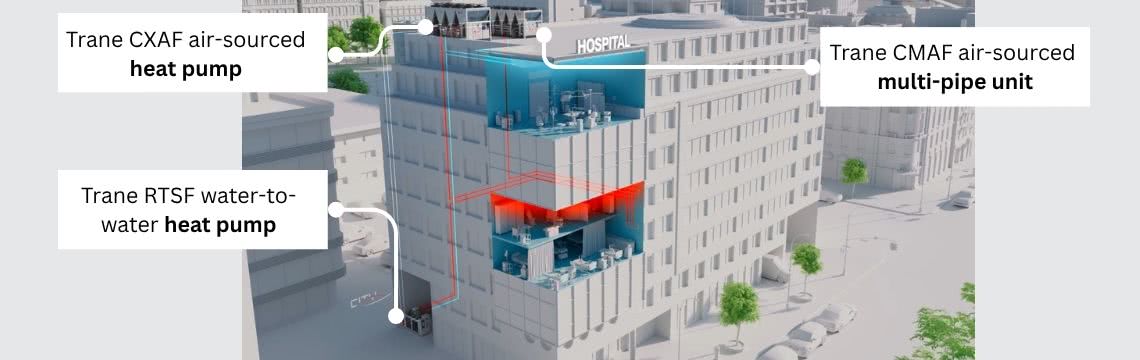
Hospitals - Hospitals have some of the most demanding thermal profiles:
• Surgical areas need constant cooling to maintain strict air quality.
• Patient rooms may need heating - especially in winter.
• Domestic hot water must be produced 24/7.
That means cooling and heating run simultaneously, all year long. With a Thermal Management System, the heat produced by cooling sensitive medical spaces can be reused to help generate domestic hot water or heating somewhere else in the building.
Hotels - Hotels have a similar challenge:
• Guest rooms require cooling in summer.
• Kitchens, laundry, and wellness areas create internal heat.
• Hot water demand stays high year round.
Traditional HVAC would dump the by-product heat outdoors, while boilers burn gas to heat water. A Thermal Management System captures that same heat and repurposes it - reducing energy waste dramatically.
Commercial Offices - Yes, even office buildings have mixed needs:
• Sun exposed facades may require cooling.
• Shaded sides or ground floors may require heating.
• Meeting rooms generate internal heat loads.
• Basements or conference centers may need heating at the same time.
Thermal Management Systems excel in these real world mixed conditions, making them far more efficient than systems built for a one directional thermal load.
Want to learn more?
See how Gridx, a large commercial retail space in Luxemburg did it.
This episode of Healthy Spaces by Trane Technologies goes deeper into the subject: Watch the episode
Contact Us
Connect with your local Trane expert
We will help you find the needed solution