Challenge
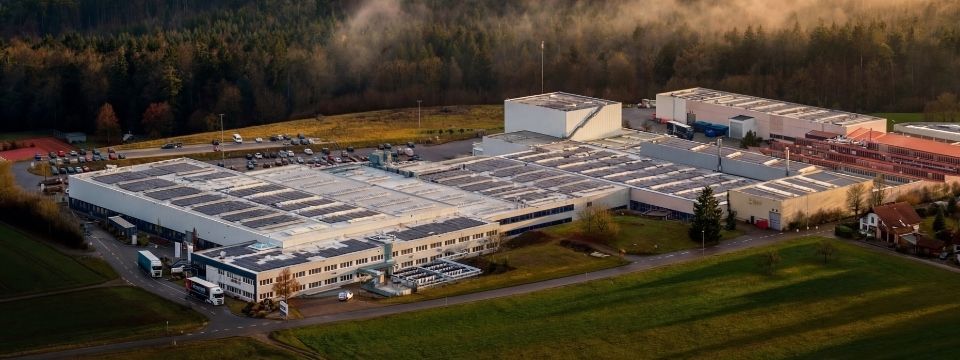
At HOMAG’s Holzbronn site, high-tech machinery and systems for the woodworking industry and skilled trades are produced every day and shipped worldwide. This energy-intensive production facility places demanding requirements on operational reliability, temperature control and efficiency.
With the parent company's goal to reduce GHG emissions by 30% by 2035, the entire heat supply was to become carbon-neutral, without compromising process stability or comfort. The ideal heat management solution was created with Trane high efficiency heat pumps.
Four old oil-fired boilers had to be decommissioned and replaced by a future-ready, fully renewable electric heating system.
Solution
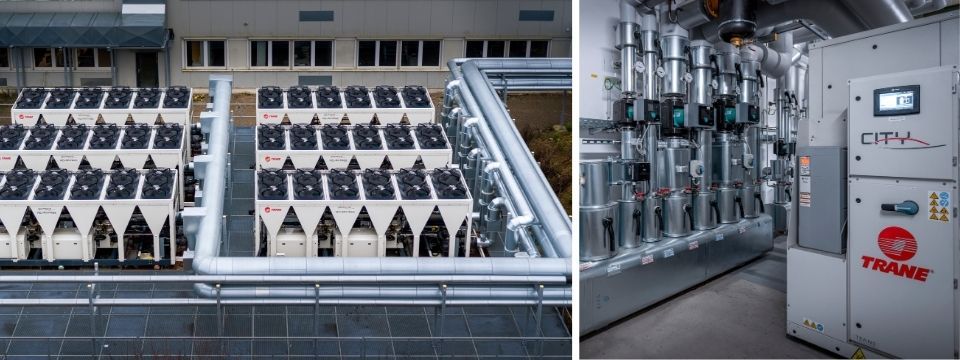
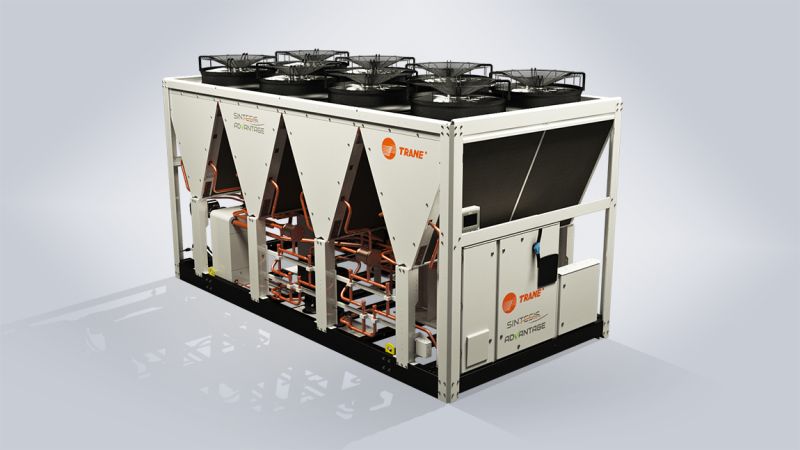
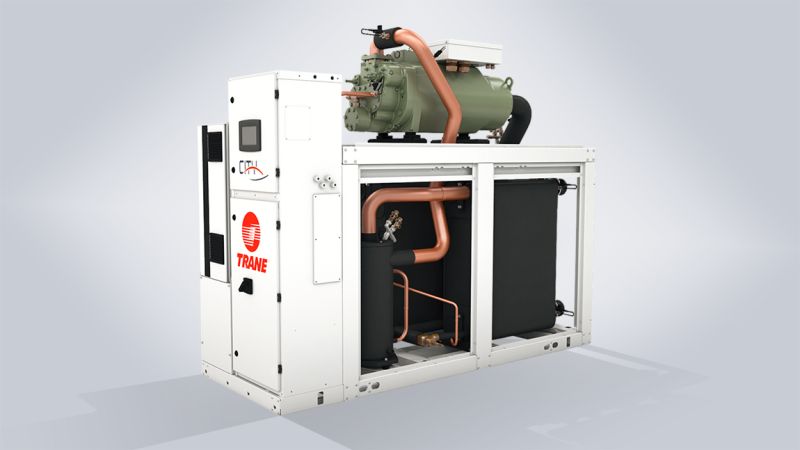
The solution selected was a combination of six Trane CXAF air-to-water heat pumps and one Trane RTSF HT (High Temperature) heat pump. Combined, these units cover both low-temperature and high-temperature applications up to 120°C, providing the flexibility required for industrial use. At the same time, they deliver maximum efficiency with high operational reliability.
The six installed Trane CXAF units provide a combined heating capacity of 2.316 MW at winter outdoor temperatures of –12°C and a heat sink temperature of 50/43°C (heating supply/return temperature). Thanks to their reversible operation, they can not only provide heating but also contribute to cooling the office areas during the summer months.
The additional Trane RTSF high-temperature heat pump delivers 145 kW at a supply temperature of 70°C. It ensures that all areas requiring high-temperature heat can also be supplied regeneratively.
The entire heat distribution system is based on a hydraulically efficient pipe network comprising more than seven kilometres of black steel pipe, transporting energy efficiently to the production and office areas. In addition, 128 new unit heaters were installed to ensure uniform, robust and low-maintenance heat transfer. In combination with the central buffer tank, this created a system capable of absorbing peak loads while also covering continuous base load demand. In this way, it makes a significant contribution to a stable and consistent indoor climate.
Results
The result is a solution that is economical, sustainable and future-focused. It shows how companies in energy-intensive sectors can take responsibility today without compromising on quality or productivity.
Part-load efficiency of Trane heat pumps is especially important, as production facilities do not operate with a constant energy demand. The heat pumps can adjust output accordingly, avoiding unnecessary energy consumption. At the same time, the modular structure of the system provides built-in redundancy — a critical factor for industrial operators that depend on fail-safe performance.