
The key to unlocking energy savings in your HVAC system is to think of it as a thermal management system rather than siloed heating and cooling plants. Heat pump technology enables this approach... but did you know that there are different types of heat pumps on the market?
One of the most advanced types of heat pump is the multi pipe or four pipe unit , sometimes called a multi purpose unit.
Here are 5 things that make a multi-pipe heat pump special:
1. It can heat and cool simultaneously
Unlike a traditional chiller or heat pump, a multi pipe unit can heat, cool, recover heat - or do all of these at the same time. This allows it to satisfy the real time needs of different building zones.
2. It has three heat exchangers
These include:
• A heat exchanger connected to the cooling circuit
• A heat exchanger connected to the heating circuit
• An air heat exchanger
The air heat exchanger plays a balancing role, either handling excess heat or supplementing renewable heat (from the ambient air) when the building needs more. This heat exchanger works either as a condenser in the cooling mode, or as an evaporator in heating mode to balance the difference between the heating and cooling demands.
3. It repurposes energy which would otherwise be rejected
Heat is an unavoidable by-product of any cooling process. In conventional cooling plants, it is typically rejected to the ambient air – an absurdity if you can consider that many buildings (like hospitals and hotels) require simultaneous heating and cooling all year round. Thanks to the additional heat exchanger, multi-pipe heat pumps can simultaneously capture and re-purpose this waste heat to meet the building’s heating demand. This flexibility is the backbone of its efficiency.
4. TER is used to compare different brands of multi-pipe products
Because a multi-pipe heat pump is unique and sophisticated in the way it can deliver heating and cooling simultaneously, EER and COP were not representative enough of its performance level. Therefore, the industry felt the need to create a new energy efficiency ratio called Total Efficiency Ratio, or TER.
What is TER? TER = (Cooling capacity + Heating capacity) / Total power input
A high TER means that the cooling and heating demands of a building are completely balanced. For example, the Trane Sintesis™ Balance CMAF offers Total Efficiency Ratio (TER) of up to 8.5, one of the highest levels of all air-sourced multi-pipe units available on the European market.
TER is commonly used by designers to compare Eurovent-certified multi-pipe units.
5. It uses an innovative refrigerant system
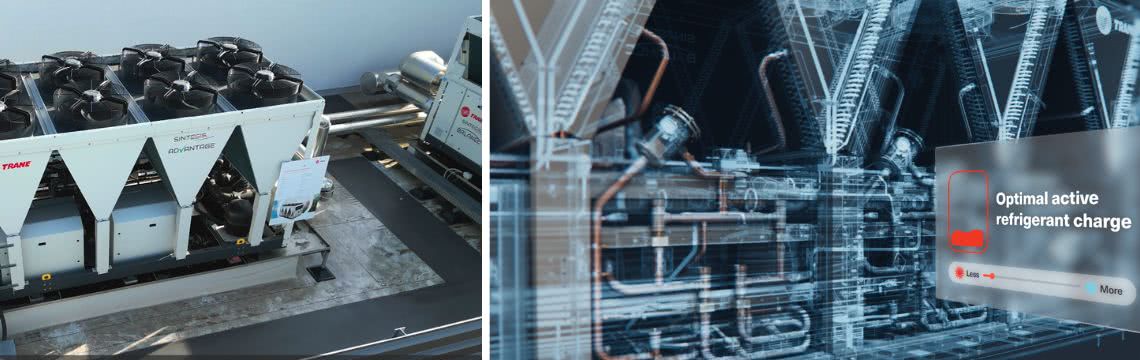
Traditional heat pumps operate with a fixed refrigerant charge, but refrigerant charges need to vary depending on whether the system is heating, cooling, or recovering energy. To solve this and optimize efficiency no matter what the operating condition, Trane has designed and implemented the Trane Adaptive Refrigerant System (TARS). This patented technology automatically adjusts the refrigerant charge based on the operating mode, ensuring the system always runs at optimal performance.
Learn more about TARS in this video
Why are multi-pipe heat pumps growing in popularity?
According to Eurovent market intelligence, the multi-pipe heat pump market in Europe has more than doubled over the past 5 years. Below are the top 3 reasons why designers and building owners are opting for this unique technology for comfort applications.
1. Lower Operating Costs
Reusing heat from cooling means you pay less to generate heat. Electricity use is becoming more productive. Seasonal energy bills drop significantly.
2. Lower Carbon Emissions
Because electricity powers the system, and the equipment is 3–4 times more efficient than combustion-based heating, emissions can drop by factors of up to 5 depending on your building’s usage patterns. For owners pursuing ESG goals or carbon neutral targets, this is a major enabler.
3. Smaller Mechanical Footprint
Replacing separate boilers and chillers with an integrated solution frees up space in mechanical rooms, reduces maintenance complexity, and lowers equipment redundancy requirements. In new constructions, this can even reduce capital investment.
4. Higher Building Value
Investors and tenants increasingly demand buildings that use renewable ready electricity, reduce carbon footprint, lower operating costs, avoid air pollution and, of course, provide stable and comfortable environments.
Thermal management systems, including multi-pipe heat pumps, check all these boxes.
Learn more about Trane’s Multi-Pipe Heat Pumps
See more in this video
Contact Us
Connect with your local Trane expert
We will help you find the needed solution