
By Grigory Ulubabyants, Services Product Manager at Trane Technologies
When we look at the energy market, there’s always a segment that needs electricity 24/7. In those cases, the usual answer was always simple: a stand alone genset running nonstop.
That’s all... right? Well, not exactly.
What happens if we add a battery into the mix – not for backup, but for real efficiency? At first, that might sound strange, because batteries aren’t exactly the cheapest part of the system. But technology has moved fast, and modern battery systems are reliable, robust, easy to integrate, and – most importantly – smart.
Today’s batteries can control external power sources based on parameters like state of charge, discharge speed, energy demand, and even time of day.
What does that have to do with a genset?
Most electrical loads aren’t constant. In fact, they fluctuate a lot. Gensets are generally sized for the peak loads. That means the genset is running far below its efficient point for most of the time. In many real applications, loads sit between 20% and 70% of the genset’s rated power.
A genset running at 20% load is far less efficient than one running at its ideal 80%.
Every litre of diesel produces much more electrical energy when the genset is operating near that sweet spot of 80%.
That’s exactly the idea behind a hybrid genset: run the engine at its most efficient point (around 80%) to charge the battery and let it handle the variable load.
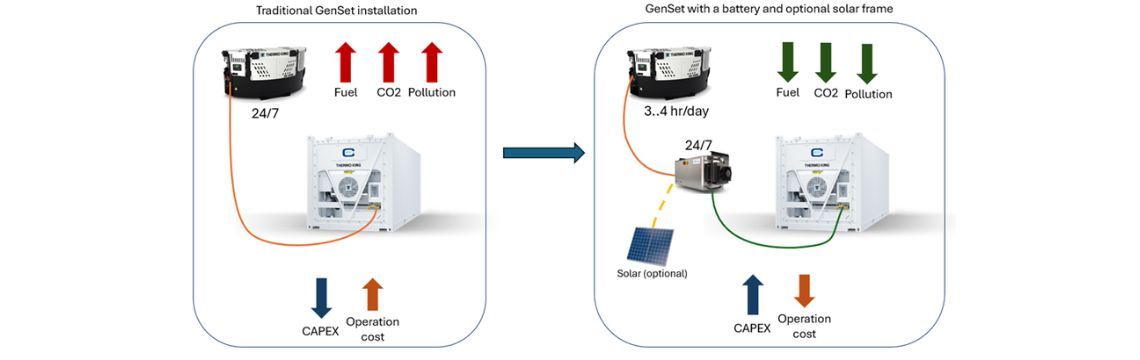
Main Benefits of the Genset + Battery Combination
1. Fuel savings – the genset runs fewer hours and only at its most efficient point.
2. Lower CO₂ emissions – less fuel burned = fewer emissions.
3. Reduced noise and pollution – and you can even limit genset operation to “allowed” hours, like 7:00–18:00.
4. Lower service and maintenance cost – fewer running hours mean fewer oil and filter changes and longer intervals.
5. Even better with solar – add PV panels and the genset may only run a few hours per day.
Example 1: Cold Storage Container, 15 kW Genset
A cold storage container runs 24/7 on a 15 kW genset in a remote location. Average load: ~2 kW Peaks: 6–7 kW Daily fuel consumption: ~25 litres
Switching to a hybrid setup, we run the genset at a stable 11 kW to charge the battery.
Genset run time: ~3 hours/day Fuel consumption: ~10 litres/day
That’s 15 litres saved every day, equal to 40.5 kg of CO₂ avoided.
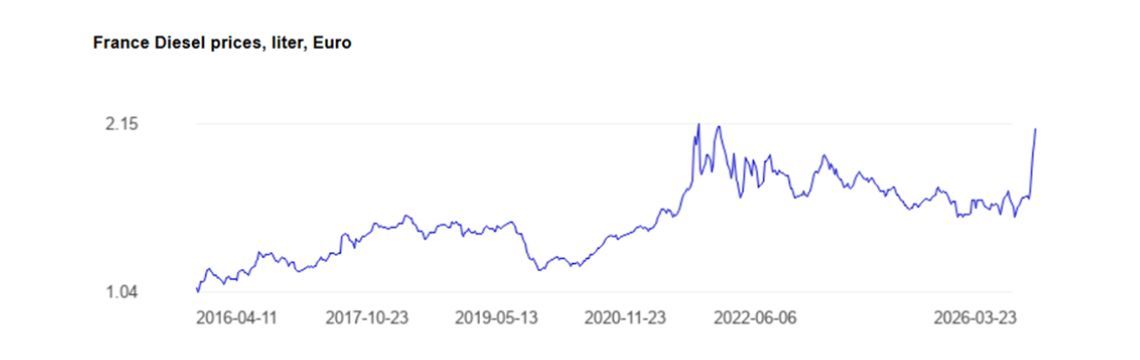
At a diesel price of 2.05 EUR/L, that’s roughly 31 EUR saved per day.
Service interval example: A 3000 hour service in 24/7 operation happens every ~4 months. At 3 hours/day, the same interval stretches to ~1000 days (~2.5 years).
That’s 7–8x fewer services and far fewer engine hours overall.
Example 2: Larger Site with a 150 kW Genset
A site is powered by a 150 kW genset, running continuously. Average load: 70 kW Peak load: 120 kW Typical daily fuel consumption: 220-250 litres
Using a hybrid setup, the genset runs at its efficient point – around 120 kW – only long enough to generate the daily energy needed:
70 kW × 24 h = 1680 kWh per day
At 120 kW output, the genset must run roughly:
1680 kWh ÷ 120 kW ≈ 14 hours per day
Fuel consumption at this efficient load is around 13-14 L/h, giving about 185 litres/day.
That’s a reduction of 55-65 litres per day, equal to 150-170 kg of CO₂ avoided daily.
With diesel at 2.05 EUR/L, that’s about 123 EUR saved per day.
Service impact: 24/7 operation hits 3000 hours in ~4 months. 14 hours/day reaches 3000 hours in ~215 days – a 40-45% extension.
And again: add solar, and the genset runtime drops even further.
What About Cost and ROI?
A hybrid genset + battery solution does have higher upfront cost. But the fuel savings are so significant that typical ROI ranges from 1.5 to 3 years.
And if CAPEX is limited, we can also offer this solution as a rental setup. That way, customers still benefit from reduced operating costs, far fewer service hours, and much less exposure to fuel price fluctuations – without needing to invest upfront.
Conclusion
These examples show that even applications built around permanent, always on gensets can greatly benefit from adding a battery. In many cases, you’re not increasing the total cost of operation at all – you're actually lowering it. Fuel savings alone often offset the battery investment, and the system pays for itself in a short time.
The result is lower fuel use, fewer service intervals, reduced emissions, less noise, and longer engine life. And if you run the genset on HVO (Hydrotreated Vegetable Oil) instead of regular diesel, the CO₂ footprint drops even further.
Hybrid systems aren’t just for niche or experimental projects anymore. They make sense for real world industrial and commercial applications where reliability, efficiency, and cost matter. And as technology keeps improving, the benefits only grow.
Gensets and battery energy storage systems are part of Trane Rental Services’ broad portfolio.
Request a free quote today
Contact Us
Connect with your local Trane expert
We will help you find the needed solution